A good edit makes a research abstract easier to read while leaving the experiment intact. That sounds straightforward until a small change replaces “was associated with” with “improved,” removes the words “in cultured cells,” or turns a measured laboratory signal into a claim about human health.
An abstract is short enough that every noun and verb carries substantial weight. The editor’s job is to reduce avoidable effort for the reader, preserve the information that defines the study, and flag questions that require the author’s scientific judgment. A practical workflow starts with meaning before moving to sentence polish.
Make a fact sheet before editing sentences
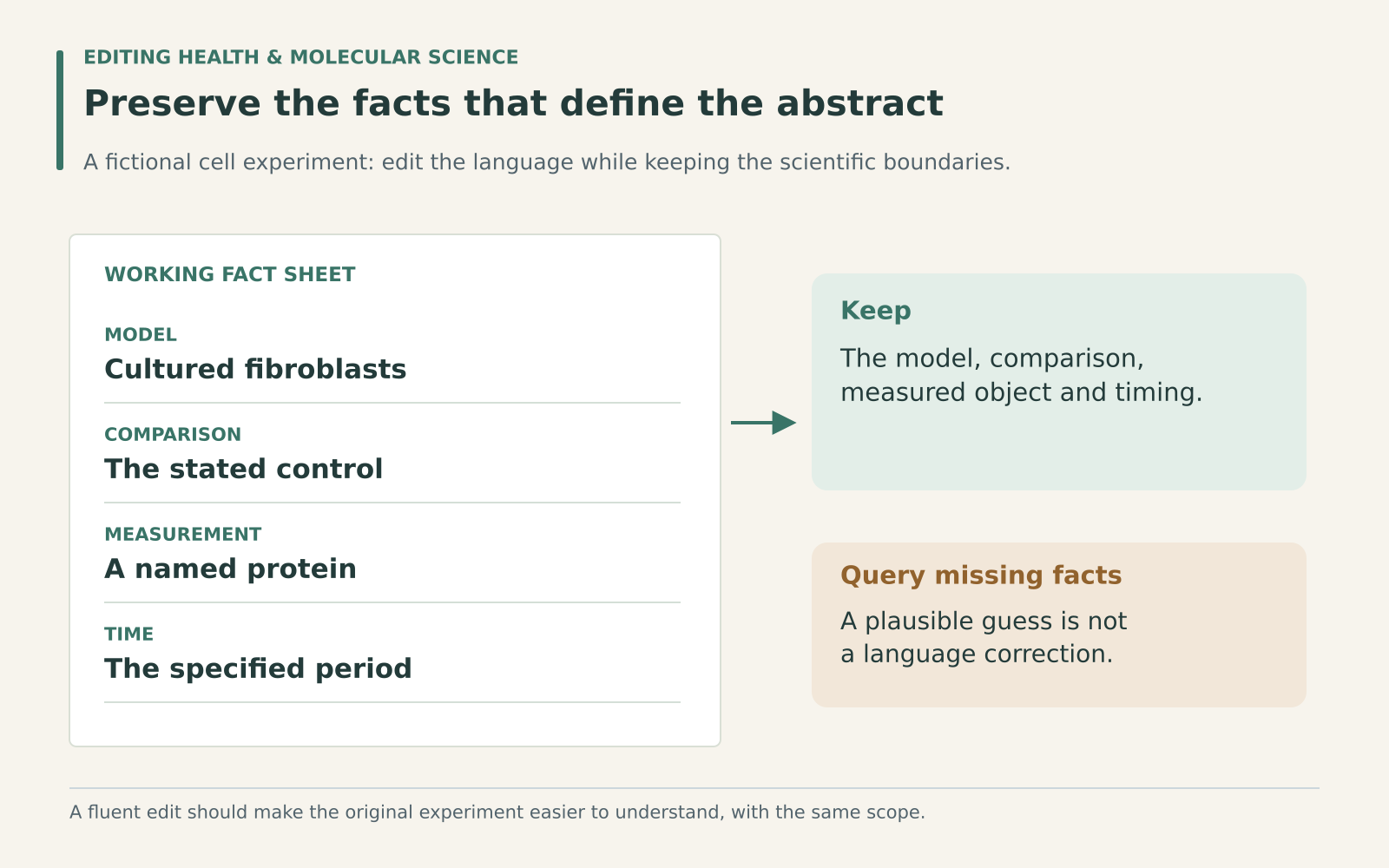
Read the abstract once without changing anything. On a separate page, record the study design, participants or experimental model, comparison, main measurement, time period and stated finding. These entries become a compact reference against which to check the edited version.
Suppose an invented abstract describes a peptide experiment in cultured fibroblasts. Its main outcome is the amount of a named protein after a specified observation period. Your fact sheet should retain those details. “Skin repair” would be a broader outcome, and “patients” would describe a different research setting. Neither belongs in the edit merely because it sounds more accessible.
When information is absent, leave a question for the author. Do not quietly fill the gap with a plausible assumption. A blank comparison group is a substantive issue, while a repeated phrase may be a routine language problem.
Use headings to expose the argument
The National Library of Medicine explains structured abstracts as summaries divided into labelled sections. The labels help readers locate information such as the study’s purpose, methods and findings. Different article types and journals can use different structures.
Even when the final abstract must be unstructured, temporarily assigning each sentence a role is useful. Mark it as background, question, method, result or interpretation. If three sentences provide background but none identifies the comparison, the imbalance becomes visible before you spend time refining adjectives.
Do not force every abstract into identical headings. Use the target journal’s requirements and the actual study type. The editing exercise is a way to inspect the information, not permission to change the research design.
Keep the measurement attached to its object
Many unclear sentences contain a measurement word without a clear object. “Expression increased” leaves the reader asking what was expressed, how it was measured and relative to what. Replacing it with “the treatment worked” removes even more information.
A stronger edit might name the measured RNA, protein or assay signal, provided the manuscript supports that wording. Where the term itself requires explanation, a short definition can help. The definition should explain the object rather than substitute a more exciting outcome.
Here is a fictional editing pair. Original: “Following application, a significant enhancement was observed.” Better query: “Please identify the measured outcome, comparison and uncertainty.” There is no responsible polished replacement until those facts are supplied. Recognizing when to ask is part of skilled editing.
Choose verbs that preserve the study design
Observed, measured, estimated, compared and tested describe different actions. Associated, predicted and caused describe different relationships. Read every central verb against the methods section, especially when the abstract moves from results to conclusions.
For an observational example, “people reporting exposure A also reported outcome B” does not automatically support “A produced B.” A clearer sentence can still be concise. Often the best improvement is to name the population and relationship directly rather than replacing cautious language with a stronger causal verb.
The same applies to experiments. A controlled change can support a causal interpretation within its design, but that does not remove limits concerning model, outcome or timeframe. A cell experiment remains a cell experiment after the prose becomes more fluent.
Edit numbers with their definitions intact
Numbers need labels. Record the unit, denominator, comparison and time point before shortening a numerical sentence. A percentage without its denominator can become ambiguous, and a difference between groups can be confused with a change within one group.
Imagine a fictional result reported as “a 6-point increase.” Does that mean six percentage points, six units on a questionnaire, or six units of an assay? The editor should resolve the label with the author, then preserve the same terminology in the abstract, table and figure legend.
Rounding also deserves a deliberate pass. A rounded percentage should remain compatible with the underlying counts. When two values are nearly equal, removing decimal places may hide the very comparison the sentence describes. Follow the journal’s conventions while protecting the information the reader needs.
Keep the conclusion proportional to the result
The ICMJE manuscript-preparation recommendations call for abstracts that accurately reflect the article, include the essential findings and limitations, and avoid overinterpretation. They also emphasize consistency between the abstract and the full manuscript.
A useful editing test is to underline each noun in the conclusion and locate its evidence in the results. If the conclusion introduces a new patient group, functional benefit or application, ask whether the paper actually measured it. A proposed application may belong as a qualified implication rather than as an established finding.
For the fictional fibroblast experiment, “supports further investigation of this cellular response” has a different meaning from “provides a treatment for skin damage.” The distinction concerns evidence, not merely tone.
Cut repetition before cutting scientific boundaries
When a word limit is tight, remove duplicated background, unnecessary announcements and phrases that add no information. “It is important to note that” usually contributes less than the model name or observation period that follows it.
Keep a small deletion log for meaningful changes. If you remove a limitation because it is stated elsewhere in the abstract, note where it remains. If there is no remaining location, reconsider the deletion. A shorter abstract should not require readers to guess which qualifications disappeared.
Read the revised paragraph aloud after this pass. Long chains of modifiers often reveal themselves through rhythm. Break the sentence at a logical boundary while retaining the connection between the experiment and its result.
Finish with a meaning comparison
Place the original, the edited abstract and the fact sheet side by side. Check the model, comparison, outcome, units, timing and central verbs. Review the title too: a precise abstract can still be undermined by a title that promises a different result.
Finally, separate language corrections from scientific queries in your handoff. The author should see which changes improve expression and which decisions require confirmation. This makes the edit useful, reviewable and faithful to the research the abstract is meant to represent.